
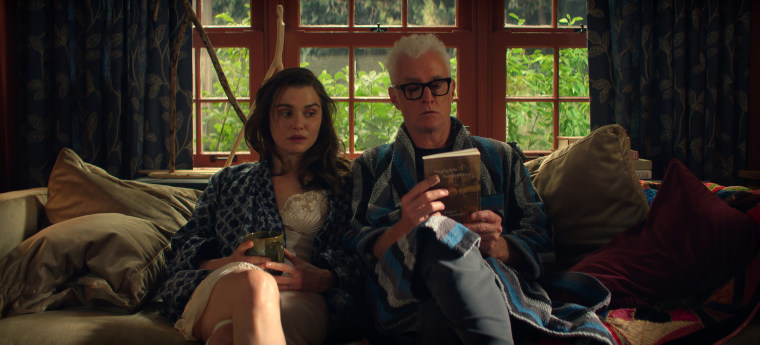
Netflix’s Vladimir delivers one of the most unsettling and ambiguous finales of the year, leaning fully into its themes of obsession, power, and unreliable narration.
Led by Rachel Weisz as the unnamed Protagonist and Leo Woodall as Vladimir, the limited series builds toward a finale that blurs the line between reality and fantasy. By the end, viewers are left questioning not just what happened, but whether anything we saw can be trusted at all.
TL;DR
Netflix’s Vladimir ends on a deliberately ambiguous note. The Protagonist does sleep with Vladimir, but their relationship is toxic and manipulative. The final fire raises major doubts, and the show leaves it unclear whether Vlad and John survive or if the narrator is telling the truth.
Here is a full breakdown of the ending and what it likely means.
What Happens at John’s Hearing?
[my_movie_db id=285739 type=tvshow]
John’s academic misconduct case plays a major role throughout the season. Played by John Slattery, John faces serious allegations that threaten both his career and reputation.
The Protagonist spends much of the series trying to control the outcome of the hearing, partly to protect her own standing. Her efforts include attempting to delay proceedings and quietly managing people who could damage the case.
One of the most important threads involves Lila, a former student. It is revealed that The Protagonist may have previously acted against Lila out of personal resentment, potentially linked to Lila’s past involvement with John. While she denies any bias, the situation casts doubt on her integrity.
In the end, the case reaches a compromise. The complaints against John are dismissed, but he is forced out of teaching. He keeps his pension, which he considers a win, though it comes at a personal cost. His relationship with his daughter is strained, and his marriage is effectively beyond repair.
Do The Protagonist and Vladimir Actually Get Together?
One of the central questions throughout Vladimir is whether the Protagonist’s obsession ever becomes real.
The show repeatedly uses fantasy sequences, with the Protagonist breaking the fourth wall and imagining intimate moments with Vladimir. These scenes are stylized and clearly framed as daydreams.
However, the finale presents a turning point.
At the cabin, the Protagonist and Vladimir do sleep together. Unlike previous scenes, this moment is grounded in reality and lacks the surreal tone of her fantasies. That said, the context makes it deeply disturbing rather than romantic.
She manipulates the situation by drugging Vladimir, restraining him, and misleading him about his wife’s supposed affair. This creates a scenario where consent and truth are heavily compromised. What might initially seem like the culmination of her desires is actually the clearest example of how far her obsession has spiraled.
Bottom line: Yes, they do have a physical relationship, but it is not a genuine or healthy connection. It reinforces the show’s darker themes rather than delivering a romantic payoff.

What Really Happens in the Fire?
The finale’s most debated moment is the fire at the cabin.
After the encounter with Vladimir, the situation escalates into chaos. The Protagonist ultimately leaves both Vladimir and John inside the burning cabin while she escapes with her manuscript.
This moment is symbolic as well as literal. Throughout the series, her writing has been shaped by her obsession with Vladimir. Saving the manuscript suggests she prioritizes her narrative over the people in her life.
In the final scene, she tells the audience that she called emergency services and that both men survived.
But here is the key issue. We never see proof.
Given everything the show has established about her unreliable perspective, there is strong reason to question this claim.
Is The Protagonist Telling the Truth?
The defining feature of Vladimir is its use of an unreliable narrator.
From the beginning, the Protagonist speaks directly to the audience, shaping how we perceive events. She presents her version of reality with confidence, but cracks begin to show as contradictions and manipulations surface.
By the finale, the audience is forced to reassess everything.
Her claim that Vlad and John survived could be true. It is also entirely possible that she is rewriting events to protect herself from guilt or to create a more satisfying ending.
The same ambiguity applies to her final update about her book. She says she published a novel inspired by her experiences and that it outperformed Vladimir’s own work.
This part feels more believable. Her writing arc has been consistent throughout the series, and it aligns with her character’s motivations. But even here, we are still relying solely on her word.
Does She End Up With Vladimir?
No, she does not.
Despite her intense fixation, Vladimir is not a love story. It is a study of obsession, projection, and control.
By the end, any illusion of romance has completely collapsed. Their connection is revealed to be one-sided, distorted, and ultimately destructive. Whether Vladimir survives or not, there is no future between them.
What the Ending Really Means
At its core, Vladimir is less about what literally happens and more about perspective.
The series invites viewers to question how stories are told and who gets to tell them. The Protagonist, as both narrator and writer, controls the narrative in ways that blur truth and fiction.
Her final message to the audience feels almost like a challenge. Do you believe her?
That question is the real ending.
Much like the literature she teaches, Vladimir does not offer a single correct interpretation. Instead, it leaves viewers with uncertainty, encouraging them to examine the gaps between what is shown and what is said.
Check out It’s Netflix Nerd for our latest reviews, updates, release news, and information about Netflix movies and series.