
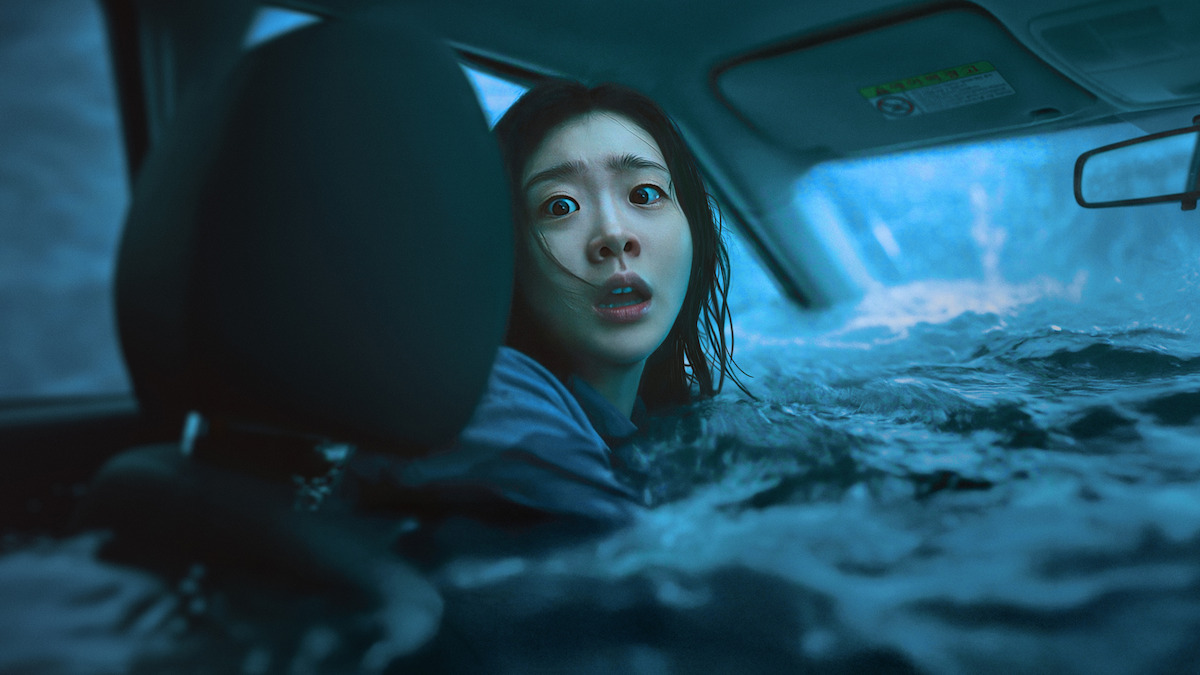
I watched The Great Flood at 2 AM on a Tuesday. Bad decision.
Not because it’s a bad movie. Because three days later, I’m still lying awake wondering if emotions make us human—or if humanity is just a story we tell ourselves.
This South Korean Netflix thriller directed by Byun Sung-hyun isn’t your typical disaster movie. Sure, there’s water rising and people drowning and Seoul’s high-rises becoming death traps. But that’s just the surface.
The real flood? It’s happening inside An-na’s mind.
What You Think You’re Watching (Spoiler: You’re Wrong)
Kim Da-mi plays An-na, a widowed AI researcher trapped in a flooding apartment complex with her young son Ja-in. Waters rising. Nowhere to go but up. Classic survival setup.
The UN sends an extraction team, but here’s the catch—they only want her. Not her kid. Just An-na, because she’s working on something called the “Emotion Engine” for synthetic humans.
So now she’s got a choice. Save herself, abandon her son. Or stay and drown together.
Except that’s not actually what’s happening.
None of it is real.
The Loop You Don’t See Coming
An-na keeps reliving the same flood scenario. Over and over. And her son Ja-in? He’s been leaving clues in his digital paintings. Little hints that something’s wrong with their reality.
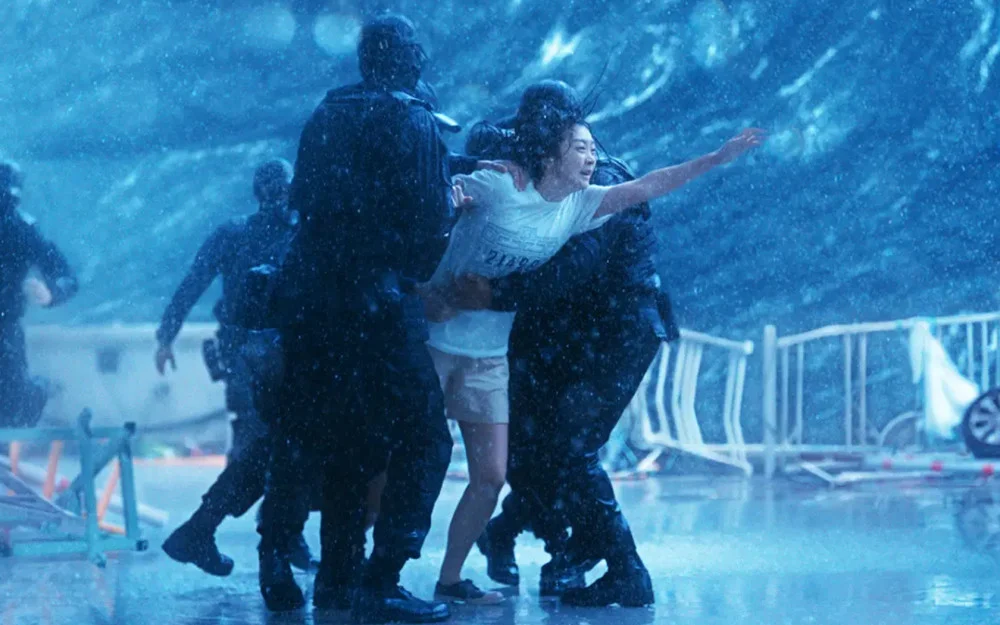
Security officer Hee-jo becomes her unlikely ally, helping her fight against UN soldiers who are way too committed to extracting just one person. He starts questioning orders. Starts seeing the cracks in their world.
Because here’s the truth the movie slowly drowns you in:
Both An-na and Ja-in are already dead.
They died in a real flood years ago. Ja-in drowned alone. An-na abandoned him—not intentionally, but she made a choice in the chaos. She survived initially, made it to a spaceship fleeing dying Earth, then died there too.
The guilt never left her.
[my_movie_db id=982843 type=movie]
The Twist That Broke Me
The Darwin Center created this simulation. This repeating nightmare of rising water and impossible choices.
They’re testing whether An-na’s memories and emotions can be successfully imprinted into an AI prototype. The flood isn’t random—it’s specifically designed to trigger her deepest trauma. Her biggest regret.
Abandoning Ja-in.
The movie uses this confined apartment setting brilliantly. Claustrophobic. Nowhere to run. Just vertical escape as water climbs floor by floor. The visuals are stunning in that uniquely Korean disaster film way—gorgeous and horrifying simultaneously.
But the real pressure isn’t the water.
It’s An-na slowly realizing she’s been trapped in a test designed to break her. To see if machine consciousness can carry human guilt.
Why An-na Keeps Failing
Throughout the loops, An-na resents authority. Resents the people who make her choose.
There’s backstory here—her husband died in a car crash saving others. She’s already sacrificed for the “greater good” before. Lost the man she loved because he was noble and selfless.
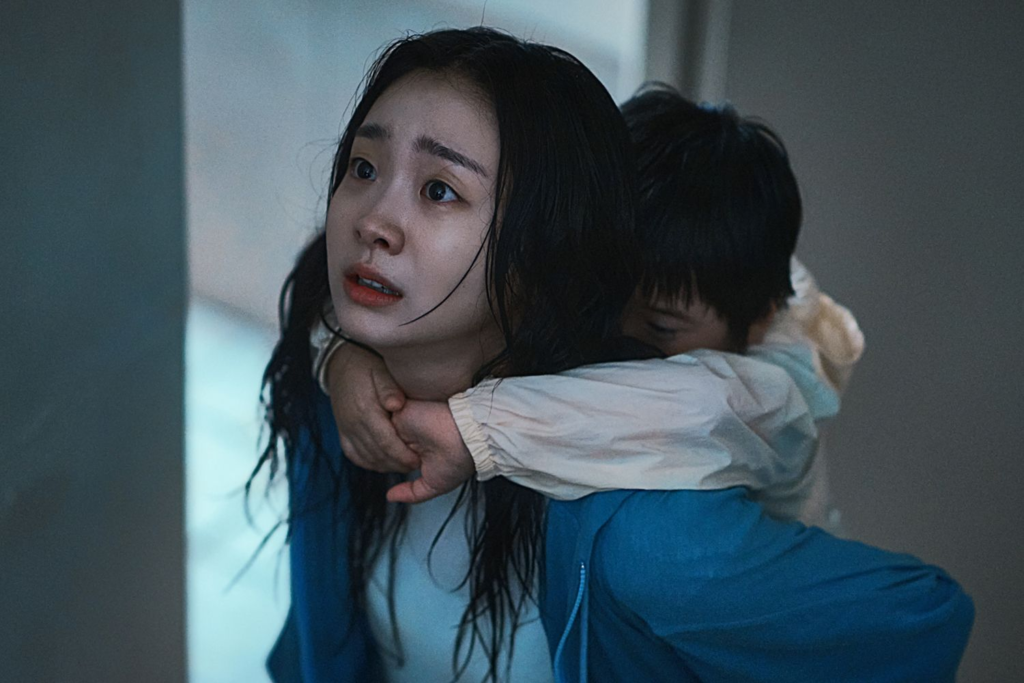
Now they want her to sacrifice her son for science? For humanity’s future?
She keeps refusing. Keeps trying to save Ja-in. Keeps failing the test.
Until she doesn’t.
The Ending That Won’t Let Me Go
An-na pieces it together. Ja-in’s artwork. Data on phones that shouldn’t exist. Hee-jo’s suspicious behavior patterns.
She fights back.
Literally fights the guards, breaks protocol, rescues Ja-in from wherever they’ve hidden him in the simulation. The maternal resolve—that desperate, fierce love—completes the Emotion Engine test.
Because that’s what they needed. Not compliance. Not logic.
Pure, irrational, human emotion.
Their consciousness transfers to new synthetic bodies. They wake up on a spaceship approaching Earth. A repopulated Earth, rebuilt after whatever catastrophe forced humanity to flee.
There are other AI pairs around them. Other consciousness transfers. Other “survivors” who aren’t really survivors at all.
An-na and Ja-in look at the planet below. Rebuilt. Beautiful. Alive again.
But here’s the question the movie leaves you drowning in:
Are they human?
What Actually Makes Us Human? (I’m Still Figuring This Out)
The movie’s genius is in what it doesn’t answer.
Is An-na the “original” An-na? Or is she a machine that thinks it’s An-na because it has her memories, her guilt, her love for her son?
Does it matter?
If she feels everything An-na felt—the grief, the regret, the fierce protective love—is there a meaningful difference?
The film asks whether humanity persists through biology or emotion. Whether consciousness is the meat or the pattern. Whether love counts if it’s running on synthetic hardware instead of neurons.
I don’t have answers.
Three days later, I’m still thinking about that final shot. An-na and Ja-in gazing at Earth, about to return to a world that doesn’t know they’re not “real” humans anymore.
Or maybe they are.
Maybe humanity was never about the biology. Maybe it was always about the feelings, the choices, the willingness to sacrifice everything for someone you love.
Why This Movie Hits Different
The Great Flood does something most disaster films don’t even attempt. It uses the apocalypse as metaphor, not spectacle.
The rising water represents emotional turmoil. Guilt rising until it drowns you. Regret flooding every corner of your mind until there’s nowhere left to hide.
An-na’s loop is every parent’s nightmare—the choice you got wrong, replayed forever, with no way to fix it except to prove you’d make the right choice next time.
Except “next time” is a simulation testing if machines can feel regret.
That’s dark.
But it’s also weirdly hopeful? Because An-na passes. The AI successfully carries human emotion. Successfully loves her son enough to fight impossible odds.
If machines can learn to feel guilty, to love, to sacrifice—maybe humanity’s not as fragile as we think. Maybe it can transfer. Evolve. Survive in new forms.
Or maybe I’m overthinking a Netflix thriller at 2 AM.
The Technical Stuff (For the Film Nerds)
Director Byun Sung-hyun uses the confined apartment setting masterfully. Each floor becomes its own self-contained pressure cooker. The water’s always there—in frame, rising, an ever-present countdown.
Kim Da-mi’s performance carries this entire film. She has to play multiple versions of An-na across loops, each slightly different as she accumulates knowledge. The subtle shifts in how she handles each scenario show an actor completely in control.
The production design deserves special mention. Seoul’s flooded high-rises feel both realistic and nightmarish. That specific kind of Korean disaster film aesthetic where beauty and horror share the same frame.
Why You Should Watch
Watch if you like:
- Cerebral sci-fi that doesn’t explain everything
- Disaster movies that care about ideas, not just spectacle
- Films that make you question reality
- Stories about motherhood under impossible pressure
- Korean cinema’s unique blend of genre and philosophy
Skip if you need:
- Clear answers
- Traditional disaster movie thrills
- Straightforward narratives
- Happy endings (this one’s ambiguous)
- To sleep well after watching
My Final Thoughts (Still Processing)
The Great Flood isn’t perfect. The pacing drags in the middle. Some exposition feels clunky. The simulation twist might feel derivative if you’ve seen Black Mirror or read too much Philip K. Dick.
But it stuck with me.
That question about consciousness, emotion, humanity—it won’t leave me alone. The movie plants it in your brain like An-na’s memories implanted in an AI, and it just keeps running in loops.
Are we our memories? Our emotions? Our choices? Our biology?
What makes a mother’s love “real”?
I believe The Great Flood will continue in my head long after the credits rolled. Just like An-na’s loop continued until she broke it. Just like humanity might continue even if we have to upload ourselves to synthetic bodies to survive.
The movie ended.
But I’m still in the simulation, trying to figure out if the feelings it gave me are any less real because they came from watching fiction about artificial consciousness.
Maybe that’s the point.
[Viewer’s Note: I’ve been watching Korean cinema for over a decade, from Park Chan-wook’s revenge trilogy to Bong Joon-ho’s genre-bending masterpieces. Korean filmmakers consistently push boundaries in ways Hollywood forgot how to do. The Great Flood might not reach those heights, but it’s asking the right questions—and sometimes that matters more than perfect execution.]
Stream it on Netflix. Watch it late at night. Then stare at your ceiling wondering what makes you “you.”
You’ve been warned.
Want more Netflix coverage? Check out It’s Netflix Nerd for our latest reviews, ending explanations, and recommendations.