

Netflix’s psychological thriller His & Hers spent six episodes making you suspect everyone—the cheating husband, the bitter journalist, the traumatized friend—before pulling off one of 2026’s most disturbing reveals. In the final 16 minutes, the series transforms from a murder mystery into something far darker: a meditation on maternal love twisted into deadly obsession. If you’re still processing Alice’s confession, Anna’s silent acceptance, or that bone-chilling final glance between mother and daughter, here’s everything you need to know about how His & Hers ended and what it really means.
TL;DR
Alice Chambers, Anna’s elderly mother, is the serial killer. She murdered Rachel, Helen, and Zoe to avenge the sexual assault they allowed to happen to Anna at age 16, which Alice discovered on old videotapes. She framed Catherine Kelly to give Anna a career-making story. The finale ends with Anna reading Alice’s confession letter and silently accepting her mother’s crimes with a proud smile, suggesting she won’t turn her in.

The Setup: Who Were the Victims?
Before we dive into the killer reveal, let’s establish who died and why their deaths felt personal to journalist Anna Andrews. Three women from Anna’s high school friend group were murdered in Dahlonega, Georgia:
Rachel Hopkins was stabbed to death in the woods after hooking up with Jack Harper, Anna’s estranged detective husband. Rachel was Anna’s former best friend who’d been secretly sleeping with Jack for months.
Helen Wang was killed at their old high school, where she worked as an administrator. Helen was part of Anna’s teenage friend circle and harbored dark secrets about their shared past.
Zoe Harper, Jack’s troubled sister, was murdered after Detective Priya Patel started connecting her to the crimes. Zoe had been friends with Anna’s group since high school.
All three deaths appeared connected to Anna—bringing her home to cover the story, keeping her investigation alive, and ultimately reuniting her with Jack and their fractured family. But the motive remained unclear until those final devastating minutes.
The Fake-Out: Catherine Kelly as Red Herring
Episode 6 spends considerable energy convincing viewers that Catherine Kelly—now going by “Lexy Jones” and working as Anna’s rival journalist—is the murderer. The evidence seems damning: Catherine vanished after a traumatic incident at age 16 involving Anna’s friend group, she returned to Dahlonega under a false identity, and she seemed obsessed with destroying Anna’s career.
The penultimate episode culminates in a brutal fight between Anna and Catherine at a remote lake house. Just as Catherine is about to shoot Anna, Detective Patel arrives and kills Catherine, seemingly solving the case with 30 minutes of runtime remaining. Most viewers likely assumed the rest would be denouement—Anna and Jack reconciling, the town healing, justice served.
Instead, the real horror was just beginning.
The Confession: Alice’s Letter
As Anna returns to her childhood bedroom at her mother Alice’s house, she discovers a handwritten letter on the desk. As she reads, Alice’s voiceover narration—which we’ve heard in fragments throughout the series—finally makes horrifying sense. It’s not philosophical musing. It’s a confession.
Alice reveals she committed all three murders, meticulously planned and perfectly executed. Here’s how it happened:
The Catalyst: Anna’s Videotapes
After Anna and Jack’s infant daughter Charlotte died from a tragic asthma attack, Anna disappeared from Dahlonega for years, unable to face the grief or her failed marriage. Alice, desperate to feel connected to her absent daughter, began watching old VHS tapes Anna had recorded as a teenager dreaming of becoming a journalist.
On one of these tapes—Anna’s 16th birthday party footage—Alice discovered something that changed everything: documentation of her daughter’s sexual assault. The video showed Helen deliberately luring Anna and Catherine into the woods, where three male party crashers were waiting. While Anna was being assaulted, Rachel, Helen, and Zoe stood nearby singing “Happy Birthday” mockingly, refusing to help or intervene.
Alice had always known Anna left that party traumatized. She never knew her daughter’s friends—the girls Anna trusted—had orchestrated and witnessed her assault, then did nothing to stop it.
The Murders: Methodical Revenge
Armed with this devastating knowledge, Alice began planning her revenge. As a professional house cleaner, she knew how to move undetected, eliminate evidence, and understand crime scenes. She used several advantages: her age, her feigned dementia, and the fact that, as she writes, “No one expects a woman to be a serial killer. Add the sin of old age, mistake determination for dementia; there I am, the picture of frailty.”
Rachel’s Murder: Alice began visiting the cemetery regularly, hoping to see Anna visit Charlotte’s grave. Instead, she witnessed Jack repeatedly hooking up with Rachel in the nearby woods—the ultimate betrayal. After watching Anna’s assault tape and seeing Rachel’s affair with Jack, Alice struck. She slashed Rachel’s tires after Jack left, leaving Rachel stranded, then stabbed her to death. Alice stripped naked and walked home through the rain, knowing anyone who saw her would assume she was a confused elderly woman having an episode, not a calculating killer.
Helen’s Murder: When Rachel’s death brought Anna back to Dahlonega to cover the story, Alice killed Helen to keep Anna in town longer. Helen’s role in orchestrating Anna’s assault made her death feel justified in Alice’s twisted maternal logic.
Zoe’s Murder: The third victim served a different purpose. Alice knew that by killing Jack’s sister, she would push Jack and Anna back together through shared grief. “Killing Rachel brought you home,” Alice’s letter explains. “Killing Helen kept you here. Killing Zoe gave you the family you lost.”
The Frame Job: Catherine as Scapegoat
But Alice’s plan went beyond simple revenge. She also wanted to give Anna something she’d lost when Lexy/Catherine stole her anchor position: a career-defining story. Alice planted evidence at the Kelly family home, framing Catherine for all three murders and ensuring Anna would have an exclusive angle on the killer’s identity.
Alice even canceled Anna and her producer Richard’s hotel reservation, forcing them to seek shelter at the Kelly residence where the planted evidence would lead Anna directly to her “scoop.” It was murder as career advancement—maternal love expressed through calculated violence.
Alice never intended to kill Catherine. She planned to frame her for the murders and let Catherine spend her life in prison, which Alice considered fair punishment for the assault Catherine also witnessed. Detective Patel killing Catherine wasn’t part of the plan, but it worked just as well: Anna got her story, the town got closure, and Alice remained unsuspected.
The Final Moment: Anna’s Choice
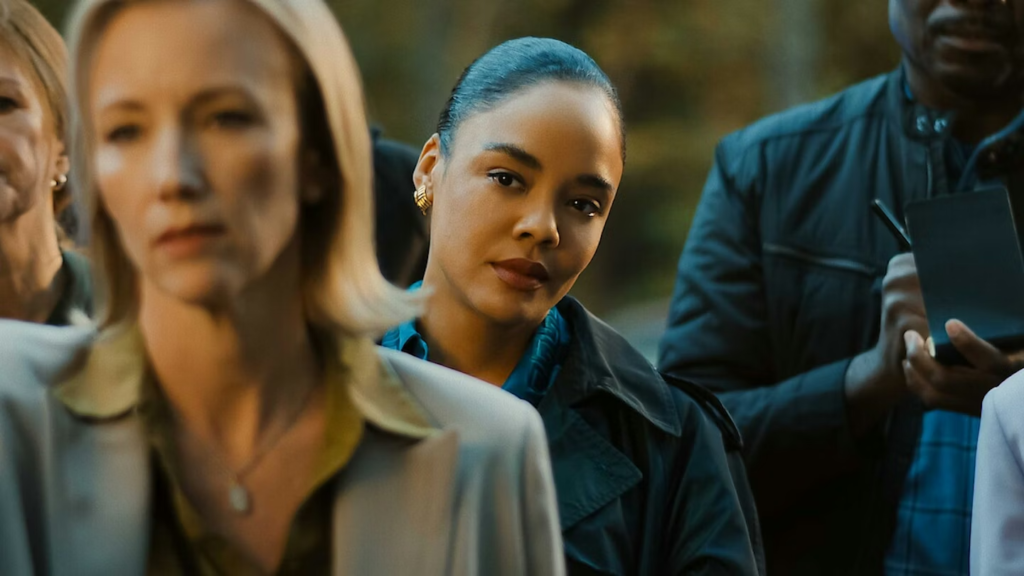
As Anna finishes reading the letter, she looks across the room at Alice, who sits silently watching her daughter. In that moment, Anna understands everything: the murders were methodical revenge for her assault, strategic manipulation to bring her home and reunite her family, and ultimately, a mother’s twisted expression of unconditional love.
The letter concludes: “A mother’s love never dims, never weakens. It’s constant, continual, relentless.”
A single tear falls down Anna’s cheek. Then she smiles—a soft, proud smile—and locks eyes with her mother. In that wordless exchange, showrunner Meaghan Oppenheimer confirms, Anna accepts what Alice did and won’t turn her in. The secret is safe.
What the Ending Really Means
His & Hers isn’t just a murder mystery—it’s an examination of how trauma, grief, and love can twist into something monstrous. Alice genuinely believes her actions were justified. She avenged her daughter’s assault, punished those who failed to protect Anna, and orchestrated events to heal Anna’s broken family.
But the series doesn’t let viewers off easy. Yes, Rachel, Helen, and Zoe enabled sexual assault, making them morally culpable for Anna’s trauma. But does that justify premeditated murder? Does maternal love excuse calculated violence? And most disturbingly: does Anna’s silent acceptance make her complicit in her mother’s crimes?
The show leaves these questions unanswered, forcing viewers to sit with the discomfort. Anna’s smile in that final moment suggests she’s grateful—proud, even—of what her mother did. She has Jack back, her career is revived, and her assailants are dead. All it cost was three lives and her mother’s soul.
As for whether Alice will ever face justice? The series suggests she won’t. She’s already faking dementia convincingly enough that police never suspected her. She’s the picture of a frail, confused elderly woman. And now her daughter—a respected journalist—will protect her secret.
His & Hers ends not with catharsis or justice, but with a deeply unsettling question: Is there anything a mother won’t do for her child? And perhaps more frightening: Is there anything a daughter won’t forgive?
Check out It’s Netflix Nerd for our latest reviews, updates, release news, and information about Netflix movies and series.