
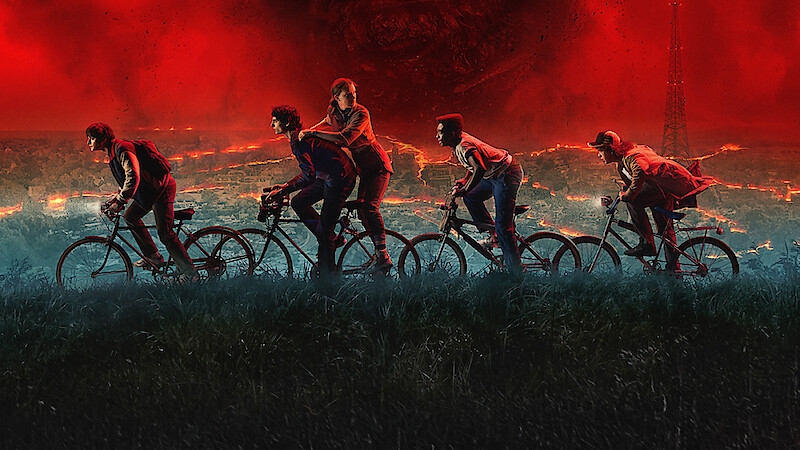
Stranger Things has evolved from a nostalgic science fiction experiment into one of Netflix’s most successful original series, captivating audiences worldwide with its blend of supernatural horror, 1980s nostalgia, and heartfelt coming-of-age storytelling. The show concluded its remarkable run with Season 5 in late 2025, marking the end of an era for fans who followed the adventures of Eleven and the Hawkins gang since 2016.
The Vision Behind Stranger Things
Brothers Ross and Matt Duffer created Stranger Things by combining their childhood influences from 1980s pop culture legends including Steven Spielberg, John Carpenter, and Stephen King. The twin creators initially struggled to break into television, with their feature film “Hidden” serving as their calling card that eventually caught the attention of M. Night Shyamalan. Their work as staff writers on Fox’s “Wayward Pines” provided crucial television experience that shaped their ability to develop and run their own series.
The Duffers originally wanted to adapt Stephen King’s “It” for the big screen but couldn’t secure a meeting with Warner Bros. This rejection proved fortuitous, as they channeled their passion for King’s work and 1980s horror into an original concept that allowed them creative freedom. The show draws thematic elements from Cold War-era conspiracy theories, secret government experiments, and supernatural horror while maintaining a sense of childlike wonder that resonates across generations.
Complete Season Breakdown
Here is the complete break down of seasons of Stranger Things.
Season 1: The Beginning (2016)
The inaugural season introduced viewers to Hawkins, Indiana, where the mysterious disappearance of Will Byers set off a chain of supernatural events. The discovery of Eleven, a young girl with telekinetic powers who escaped from Hawkins Laboratory, became central to unraveling the mystery of the Upside Down. This alternate dimension, first accidentally opened when Eleven made contact with a Demogorgon during a government experiment, served as the primary threat throughout the series.
Stranger Things Season 1 Recap
Season 2: The Shadow Grows (2017)
The second season expanded the mythology by introducing the Mind Flayer, a malevolent entity controlling the Upside Down. Will’s continued connection to this dark dimension created new dangers for Hawkins as the town struggled with the aftermath of the first season’s events. The season also explored Eleven’s backstory through her search for her mother Terry Ives and her encounter with Kali, another test subject from Hawkins Lab who had escaped years earlier.
Stranger Things Season 2 Recap
Season 3: The Mall Battle (2019)
Set during the summer of 1985, Season 3 revealed that Russian scientists were attempting to reopen the gate to the Upside Down beneath the newly constructed Starcourt Mall. The season featured major character development as relationships evolved and the group faced their biggest threat yet. The Battle of Starcourt resulted in significant sacrifices and forced the Byers family, along with Eleven, to leave Hawkins.
Stranger Things Season 3 Recap
Season 4: Vecna’s Curse (2022)
The fourth season, consisting of nine episodes released in two volumes, introduced Vecna as the primary antagonist and revealed shocking connections to the series’ origins. With extended runtimes totaling nearly 14 hours, this season became one of the longest streaming series seasons ever produced. The narrative split between Hawkins, California, and Russia, showing how the group’s separation complicated their fight against increasingly powerful supernatural forces.
Stranger Things Season 4 Recap
Season 5: The Final Battle (2025)
The fifth and final season premiered across three release windows: four episodes on November 26, three on Christmas Day, and the series finale on New Year’s Eve 2025. This eight-episode conclusion brought the Duffer Brothers’ vision full circle, with the gang launching their final stand against Vecna and the Mind Flayer. The season featured the largest and most complex battle sequence of the entire series, with Eleven, Kali, and Max attacking Vecna in his mind while Hopper and Murray prepared to destroy the Upside Down.
Main Cast and Characters
The ensemble cast became cultural icons through their portrayals of beloved characters who grew up on screen across 42 episodes. Here’s a comprehensive look at the key players who brought Hawkins to life:
The Core Kids

1. Millie Bobby Brown as Eleven/Jane Hopper
Millie Bobby Brown brought extraordinary depth to Eleven/Jane Hopper, the telekinetic girl whose journey from lab experiment to hero anchored the entire series. Her character’s ambiguous fate in the finale, where she chose to remain behind as the Upside Down collapsed, left viewers debating whether she truly survived.
2. Finn Wolfhard as Mike Wheeler
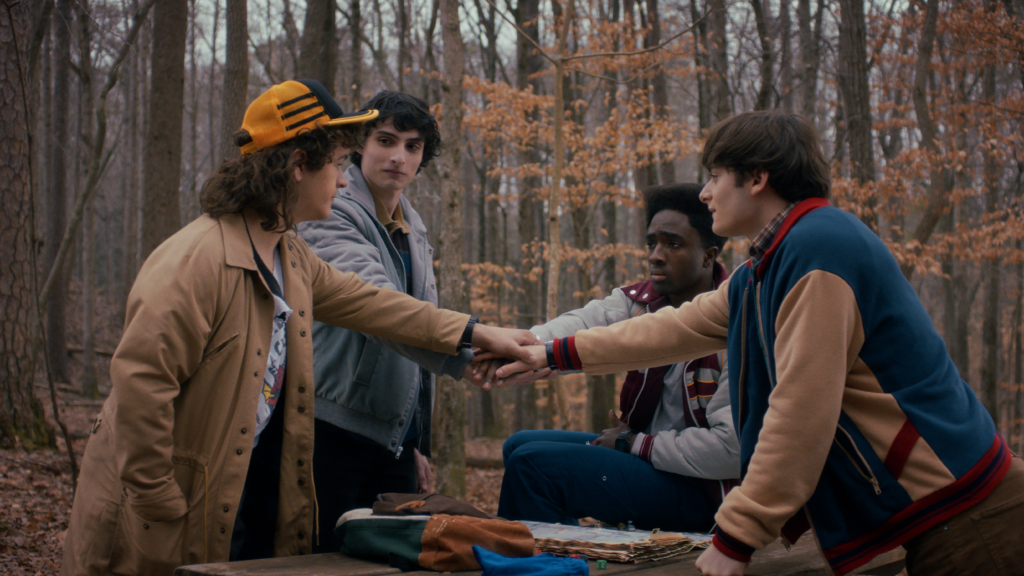
Finn Wolfhard portrayed Mike Wheeler, the heart of the friend group whose unwavering belief in Eleven and leadership skills proved crucial throughout all five seasons. His emotional range elevated Mike from typical protagonist to a genuinely compelling character dealing with love, loss, and responsibility.
3. Gaten Matarazzo as Dustin Henderson
Gaten Matarazzo delivered comedic relief and genuine emotion as Dustin Henderson, whose intelligence and loyalty made him a fan favorite. His scientific knowledge and quick thinking saved the group countless times, while his relationship with Steve became one of the show’s most beloved dynamics.
4. Caleb McLaughlin as Lucas Sinclair
Caleb McLaughlin evolved Lucas Sinclair from skeptic to brave warrior throughout the series. His protective nature toward Max and his struggles balancing popularity with friendship added layers of authenticity to his character arc.
5. Noah Schnapp as Will Byers
Noah Schnapp gave Will Byers a haunting presence as the character most connected to the Upside Down. His sensitivity and connection to the dark dimension made him both vulnerable and invaluable to understanding their supernatural threats.
6. Sadie Sink as Max Mayfield
Sadie Sink joined the cast as Max Mayfield and became integral to the story, particularly in Season 4 where her battle with Vecna provided some of the series’ most intense moments. Her iconic scene set to Kate Bush’s “Running Up That Hill” became one of the most talked-about sequences in television history, propelling the 1985 song back to the top of charts worldwide. Her portrayal of grief and trauma resonated deeply with audiences and showcased her exceptional acting range.
The Teens
7. Natalia Dyer as Nancy Wheeler
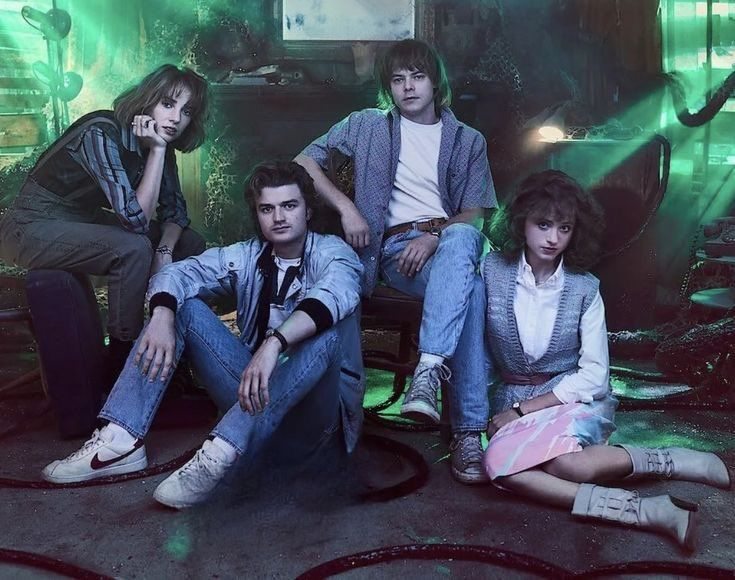
Natalia Dyer portrayed Nancy Wheeler with determination and intelligence, transforming her from popular girl to fearless investigative journalist. Her evolution into a demon-slaying hero who refused to back down from danger made her a role model for viewers.
8. Charlie Heaton as Jonathan Byers
Charlie Heaton brought sensitivity and strength to Jonathan Byers, the protective older brother whose photography skills and outsider perspective helped uncover Hawkins’ mysteries. His quiet intensity balanced the louder personalities around him.
9. Joe Keery as Steve Harrington
Joe Keery transformed Steve Harrington from high school bully to beloved protector across the series. His character’s redemption arc became legendary, evolving into the group’s unofficial babysitter and one of the most genuinely heroic figures in the show.
10. Maya Hawke as Robin Buckley
Maya Hawke introduced Robin Buckley as Steve’s witty best friend starting in Season 3. Her intelligence, humor, and representation as an openly LGBTQ+ character brought fresh energy and important diversity to the cast.
The Adults
11. Winona Ryder as Joyce Byers
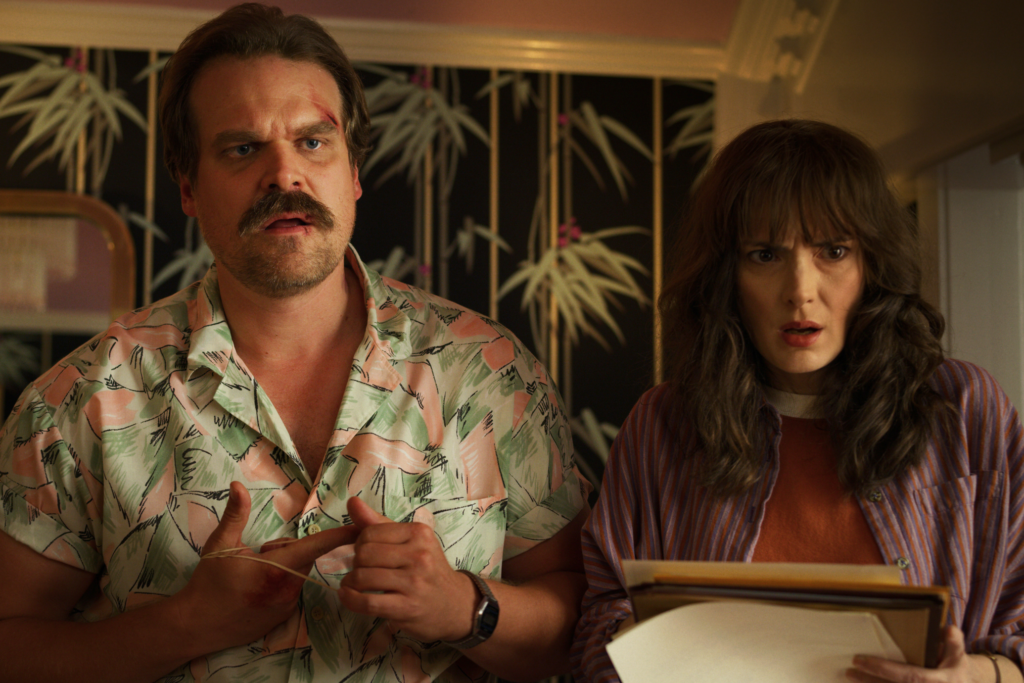
Winona Ryder featured as Joyce Byers, whose fierce maternal determination drove much of the plot. Her unwavering belief in finding Will when everyone doubted her set the tone for the show’s themes of love conquering impossible odds.
12. David Harbour as Jim Hopper
David Harbour embodied Jim Hopper, the gruff police chief who became a father figure to Eleven. His journey from cynical loner dealing with personal tragedy to protective hero willing to sacrifice everything showcased remarkable character growth.
The Villains
13. Jamie Campbell Bower as Vecna/Henry Creel/One
Jamie Campbell Bower terrified audiences as Vecna/Henry Creel, the series’ ultimate villain whose backstory connected to Eleven’s origin. His chilling performance as the show’s first test subject turned demonic entity elevated Season 4 and 5 to new horror heights.
Fan-Favorite Supporting Cast
14. Priah Ferguson as Erica Sinclair
Priah Ferguson stole scenes as Erica Sinclair, Lucas’s sharp-tongued younger sister whose intelligence and sass made her indispensable. Her transition from occasional comedic presence to full team member delighted fans.
15. Brett Gelman as Murray Bauman
Brett Gelman added conspiracy theorist Murray Bauman to the mix, providing both comic relief and crucial translation skills. His paranoid yet perceptive nature made him the perfect ally for uncovering government secrets.
16. Joseph Quinn as Eddie Munson
Joseph Quinn joined Season 4 as Eddie Munson, the metalhead Dungeon Master who became an instant fan favorite. His heroic sacrifice and genuine heart transformed him from suspected villain to beloved hero in just one season.
Season 5 Additions
17. Linda Hamilton
Linda Hamilton joined the final season, bringing her action-hero pedigree to Hawkins for the ultimate showdown.
18. Nell Fisher
Nell Fisher appeared as a new character navigating the chaos of the Upside Down’s final assault on Hawkins.
19. Linnea Berthelsen as Kali/Eight
Linnea Berthelsen returned as Kali for the final confrontation, bringing her illusion-creating powers to help Eleven in the battle against Vecna. Her comeback addressed fan requests to see more of Eleven’s “sister” in the series conclusion.
The adult cast featured Winona Ryder as Joyce Byers, whose fierce maternal determination drove much of the plot, and David Harbour as Jim Hopper, the gruff police chief who became a father figure to Eleven. Jamie Campbell Bower terrified audiences as Vecna/Henry Creel, the series’ ultimate villain whose backstory connected to Eleven’s origin.
The Stranger Things Timeline Explained
Early History (1950s-1970s)
The timeline begins with the establishment of Hawkins Laboratory and the government’s MKUltra program. Between 1969 and 1971, Terry Ives participated in MKUltra experiments while unknowingly pregnant, leading to the birth of Eleven in 1971. Dr. Martin Brenner took the infant for experimentation, setting the stage for decades of secret research.
In 1973, the MKUltura program was publicly exposed and officially halted, though Hawkins Lab continued its work in secret. The following year, Terry infiltrated the laboratory seeking her daughter but was captured and subjected to electroconvulsive therapy that left her in a permanent catatonic state. Meanwhile, other test subjects like Kali escaped and went into hiding.
The Hawkins Lab Era (1974-1983)
Throughout the late 1970s and early 1980s, Brenner continued experimenting on Eleven, developing her telekinetic abilities. The experiments escalated when Eleven was placed in a sensory deprivation tank to locate a Russian spy, during which she made first contact with a Demogorgon from the Upside Down. This encounter would fundamentally alter the fabric of reality in Hawkins.
Upside Down Explained
Season 1 Timeline (November 1983)
The main narrative began on November 6, 1983, when Will Byers vanished after encountering the Demogorgon. That same night, Eleven escaped from Hawkins Laboratory after opening a gate to the Upside Down. Over the following week, Mike, Dustin, and Lucas discovered Eleven while Joyce and Hopper investigated Will’s disappearance, eventually learning about the alternate dimension.
Season 2 Timeline (October-November 1984)
Nearly a year later, on October 29, 1984, Will experienced visions of the Upside Down while the boys visited the Hawkins Arcade. These visions revealed Will’s continued connection to the dimension and the emergence of the Mind Flayer. Meanwhile, Eleven searched for her mother and encountered Kali in Chicago, learning about other test subjects.
Season 3 Timeline (June-July 1985)
The Russians secretly attempted to reopen the gate beneath Starcourt Mall, with Dr. Alexei working on the project after a failed attempt in Russia on June 28, 1984. The summer of 1985 saw the gang discover this operation and mount a desperate defense that resulted in the apparent death of Hopper and the Byers family’s departure from Hawkins.
Season 4 Timeline (Spring 1986)
Six months after the Battle of Starcourt, the separated group faced Vecna’s emergence in Hawkins while Eleven worked to regain her powers. The season revealed that Henry Creel, the first test subject and Brenner’s original experiment, had become Vecna after Eleven banished him to the Upside Down years earlier.
Season 5 Timeline (1986)
The final season picked up immediately after Season 4, with the gang preparing for their ultimate confrontation with Vecna. The narrative showed Will’s unique insight into Vecna’s plans allowing them to set traps, while Holly Wheeler found herself exploring dangerous new territory. The climactic battle saw the team split between attacking Vecna mentally and physically destroying the Upside Down.
Series Conclusion
Season 5 premiered its first four episodes on November 26, 2025, with episodes titled “Chapter One: The Crawl,” “The Vanishing of…,” “The Turnbow Trap,” and “Sorcerer”. The highly-rated “Sorcerer” episode achieved a 9.4/10 rating from over 116,000 viewers, making it one of the top-rated episodes of the entire series.
The Christmas Day 2025 release included episodes “Shock Jock,” “Escape From Camazotz,” and “The Bridge,” building toward the finale. Episode 5 featured an electrifying plan to reconnect Will to the hive mind, while tensions flared during a search of the Upside Down’s Hawkins Lab.
The series finale premiered on December 31, 2025, both on Netflix and in select theaters, giving fans multiple ways to experience the conclusion. The ending left Eleven’s fate deliberately ambiguous, with her choosing to stay behind in the collapsing Upside Down. While Mike imagined her surviving, the Duffer Brothers left the ultimate decision to viewers.
The finale’s emotional impact centered on whether Eleven truly perished or found a way to survive, with many fans noting this ambiguity allows for potential future stories while honoring the show’s conclusion. Kali’s suggestion that staying behind would prevent scientists from using their blood to create more powered children added weight to Eleven’s sacrifice which I believe.
Soundtrack: Music That Defined a Generation
The show’s musical identity became so influential that it resurrected decades-old songs to the top of modern charts and introduced Gen Z to artists their parents loved.
Original Score by Kyle Dixon and Michael Stein
Electronic duo Kyle Dixon and Michael Stein from the band Survive created the show’s haunting original score, earning Emmy nominations for their work. Their synthesizer-driven compositions evoke John Carpenter’s horror soundtracks and 1980s sci-fi films, establishing the show’s nostalgic yet unsettling atmosphere. Key original pieces include:
- “Stranger Things Main Title Theme” – The instantly recognizable opening sequence music
- “Kids” – The emotional theme representing the core friend group
- “Eleven” – Eleven’s character motif featuring ethereal synthesizers
- “The Upside Down” – Dark, ominous tones representing the alternate dimension
- “Aftermath” – Played during emotional resolution scenes
- “Hawkins” – The small-town America theme
- “No Weapons” – Action sequence underscore
- “She’ll Kill You” – Intense confrontation music
Iconic 80s Needle Drops
The Duffer Brothers curated needle drops that served both nostalgic and narrative purposes, with each song carefully chosen to enhance character moments or themes.
Season 1
- “Should I Stay or Should I Go” by The Clash (Will’s favorite song, becomes his lifeline to the real world)
- “Africa” by Toto
- “Hazy Shade of Winter” by The Bangles
- “White Rabbit” by Jefferson Airplane
- “Sunglasses at Night” by Corey Hart
Season 2
- “Thriller” by Michael Jackson (Halloween episode)
- “Every Breath You Take” by The Police
- “Time After Time” by Cyndi Lauper
- “Dead End Justice” by The Runaways
- “The Ghost in You” by The Psychedelic Furs (Snow Ball dance scene)
Season 3
- “Never Ending Story” by Limahl (Dustin and Suzie’s duet became a viral sensation)
- “Material Girl” by Madonna
- “Cold as Ice” by Foreigner
- “Wake Me Up Before You Go-Go” by Wham!
- “American Pie” by Don McLean
- “Heroes” by Peter Gabriel (emotional Hopper moment)
Season 4
- “Running Up That Hill (A Deal with God)” by Kate Bush (Max’s escape from Vecna became the most iconic music moment in television history, sending the 1985 song to #1 on charts worldwide 37 years after release)
- “Master of Puppets” by Metallica (Eddie Munson’s guitar solo in the Upside Down)
- “Separate Ways (Worlds Apart)” by Journey
- “Pass the Dutchie” by Musical Youth
- “Psycho Killer” by Talking Heads
- “Dream a Little Dream of Me” by Ella Fitzgerald & Louis Armstrong
Season 5
- “The Power of Love” by Huey Lewis and the News
- “Elegia” by New Order
- “Fade Into You” by Mazzy Star
- “With or Without You” by U2
- Additional 80s tracks that accompanied the final battle
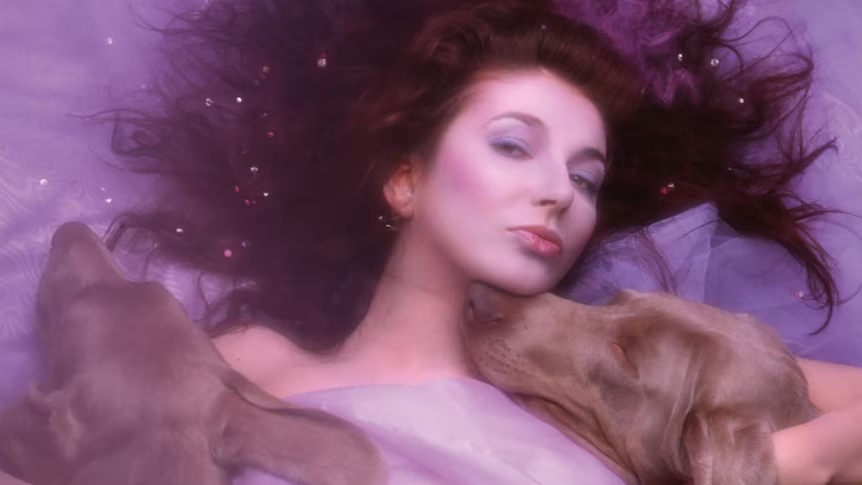
The “Running Up That Hill” Phenomenon
Kate Bush’s 1985 song became a global phenomenon when Max used it to escape Vecna’s curse in Season 4. The emotionally devastating scene sent the song to #1 in over 30 countries 37 years after its original release, introducing Kate Bush to an entirely new generation.
Eddie Munson’s “Master of Puppets”
Eddie’s epic guitar shredding of Metallica’s “Master of Puppets” atop a trailer in the Upside Down became legendary. The scene honored the 1986 thrash metal anthem while introducing younger fans to Metallica, with the band themselves praising the tribute.
The “Never Ending Story” Duet
Dustin and Suzie’s rendition of Limahl’s 1984 theme in Season 3’s finale provided perfect comedic relief during the tense Russian base infiltration, showcasing Stranger Things’ ability to balance humor with high stakes.
Snow Ball Dance Songs
The Season 2 finale’s Snow Ball dance featured period-appropriate slow dance classics that marked character growth and budding romances:
- “Every Breath You Take” by The Police (though its stalker lyrics add unintentional irony to the romantic setting)
- “Girls on Film” by Duran Duran
- “Time After Time” by Cyndi Lauper (Nancy and Dustin’s dance)
- “Love Is a Battlefield” by Pat Benatar
Stranger Things Spin-Offs: What’s Coming Next
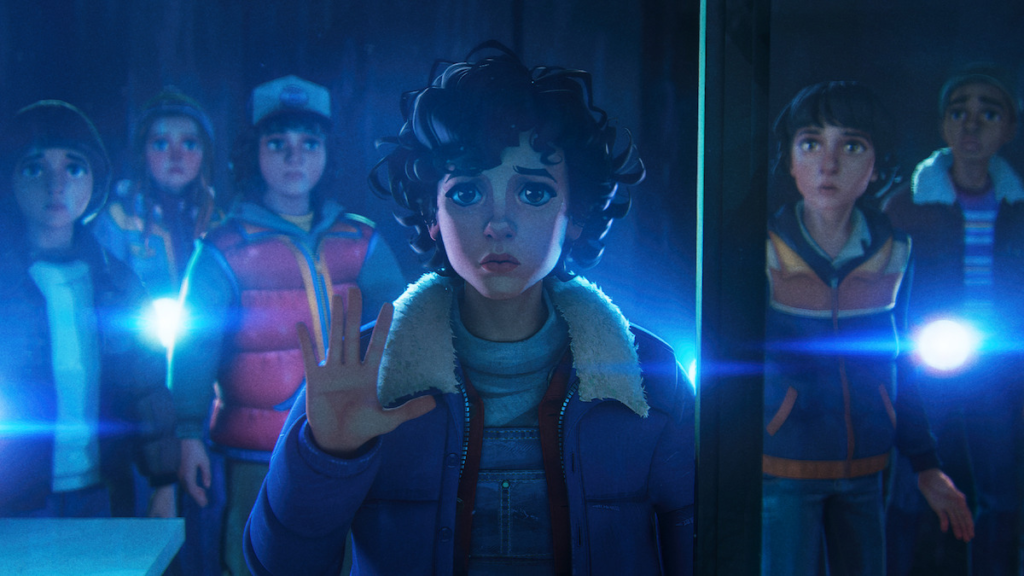
Netflix has confirmed multiple spin-offs to expand the Stranger Things universe. Here’s what’s coming:
1. Stranger Things: Tales From ’85 (Animated Series – 2026)
This animated series takes place during winter 1985, between Seasons 2 and 3. The gang faces new supernatural creatures including a giant carnivorous plant, with voice actors like Jake Gyllenhaal, Hailee Steinfeld, Kevin Bacon, and Lou Diamond Phillips joining the cast. The Duffer Brothers wanted to evoke ’80s Saturday morning cartoons, with animation allowing creative freedom to explore wilder supernatural threats.
2. Untitled Live-Action Spin-Off (In Development)
This live-action series will explore the origin of the mysterious stone Henry Creel discovered that caused the Mind Flayer to possess him. Matt Duffer confirmed the Season 5 finale deliberately left questions unanswered to connect with this spin-off. It will feature entirely new characters in different time periods or locations beyond 1980s Hawkins.
The Future of the Franchise
Netflix is expanding Stranger Things similar to HBO’s Game of Thrones approach. The Duffer Brothers hinted at more stories beyond these two projects while maintaining creative control over how the universe grows.
One Last Adventure
A new behind-the-scenes special titled “One Last Adventure: Making Stranger Things 5” is set to give fans an emotional final look at how the series wrapped up its story. The documentary’s trailer highlights cast and crew reflecting on nearly a decade with the show, intercut with on-set footage from the final season’s biggest sequences.
In the trailer, viewers glimpse table reads, stunt rehearsals, practical creature effects, and emotional goodbyes as filming on the last episodes concludes. The tone leans heavily into closure and nostalgia, emphasizing how the young cast literally grew up on set and how the production team scaled up each season to deliver a cinematic finale.
The documentary positions itself not just as a technical making-of, but as a farewell letter to fans—focusing on character journeys, fan reactions, and the cultural impact Stranger Things has had on Netflix and genre TV. It also teases never-before-seen concept art, early test footage, and candid moments with the Duffer Brothers discussing how they designed the ending from the very beginning.
Cultural Impact and Legacy
Stranger Things transformed Netflix’s original programming strategy and demonstrated the platform’s ability to create cultural phenomena that transcended traditional television. The show’s influence extended beyond entertainment, sparking renewed interest in 1980s nostalgia, synthesizer music, and Dungeons & Dragons.
The Duffer Brothers have stated categorically that Season 5 represents the definitive end of the Stranger Things story, though they’ve remained open about the possibility of spinoffs or related projects exploring different corners of the universe they created. The show’s success proved that audiences hunger for character-driven genre storytelling that balances horror, humor, and heart.
From its humble beginnings as a passion project inspired by rejected Stephen King adaptation to becoming a global entertainment juggernaut, Stranger Things achieved what many shows only aspire to: creating a complete, satisfying narrative arc that honored its characters and respected its audience. The series demonstrated that when creators have a clear vision and the creative freedom to execute it, television can deliver experiences that resonate across demographics and stand the test of time.
Check out It’s Netflix Nerd for our latest reviews, ending explanations, and recommendations.