

For nearly a decade, the Upside Down has haunted our screens, our nightmares, and every theory discussion about Stranger Things. It’s the toxic shadow world where Will Byers vanished, where Eleven banished Henry Creel, and where monsters lurk in perpetual darkness. But what exactly is this dimension? How did it come to exist? And after Season 5’s shocking revelation, do we finally understand the truth? Here’s your complete guide to Stranger Things‘ most terrifying mystery.
What Is the Upside Down?
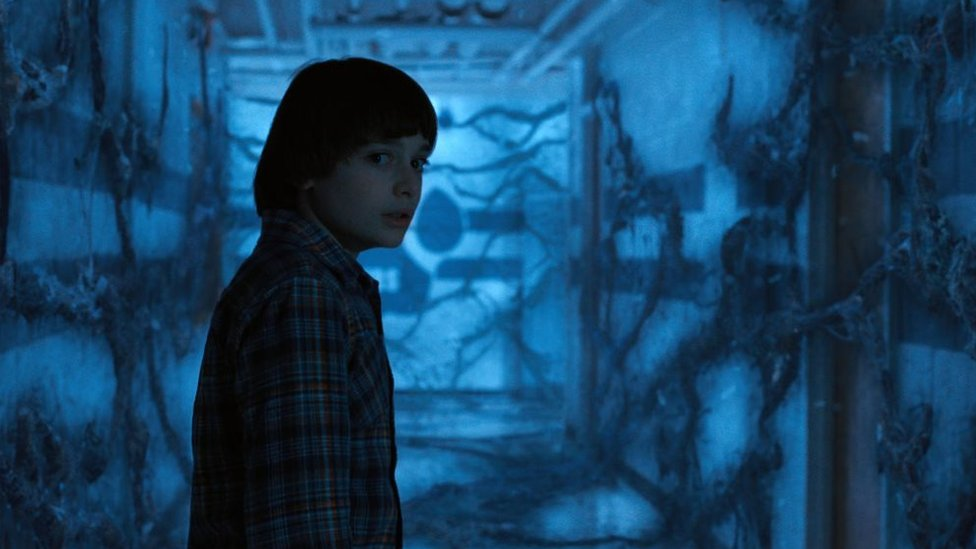
The Upside Down appears as a dark mirror of our reality—specifically, Hawkins, Indiana. It’s a parallel version of the town where buildings, streets, and landmarks exist in decaying, corrupted forms. Everything is covered in a slimy, web-like substance connected to organic vines that pulse like living veins. Ash-like spores float through the toxic atmosphere, making it nearly impossible for humans to breathe without protective equipment.
The dimension exists in perpetual darkness, bathed in an eerie red-tinged gloom. There’s no sun, no human life, no warmth—just decay, corruption, and predators. For years, fans and characters alike called it an “alternate dimension,” a parallel world existing alongside our own.
But Season 5 revealed the shocking truth: the Upside Down isn’t a dimension at all.
The Season 5 Revelation: It’s a Wormhole
In Stranger Things Season 5, Dustin Henderson makes a world-shattering discovery while exploring the ruined Hawkins Lab within the Upside Down. Hidden in Dr. Brenner’s secret journals, he finds scientific documentation explaining what the Upside Down truly is: a wormhole—a cosmic tunnel connecting two distant points in space-time.
This redefines everything we thought we knew. The Upside Down doesn’t exist as a fully formed world with its own ecosystem. Instead, it’s the bridge, the transit zone between two actual dimensions: Earth and a third realm Dustin names “The Abyss.”
Think of it this way: if Earth and the Abyss are two cities, the Upside Down is the highway connecting them. The vine-covered walls, the decaying buildings, the toxic atmosphere—all of it exists as the friction point where the wormhole pushes against physical reality, creating a distorted echo of Hawkins frozen in time.
The exotic matter discovered in Hawkins Lab acts as the glue holding this tunnel together. Without it, the wormhole would collapse into non-existence. This is why Vecna’s plan to destroy it would trigger dimensional catastrophe.
How the Upside Down Was Created
Contrary to popular belief, the Upside Down wasn’t created by Vecna, nor did it exist naturally. It was accidentally created by Eleven on November 6, 1983, during her psychic battle with Henry Creel (Number One).
When Brenner ordered young Eleven to make psychic contact with Henry in the sensory deprivation tank, she witnessed him massacring every other child at Hawkins Lab. Horrified and enraged, Eleven refused to join Henry’s vision of reshaping humanity. Instead, she used every ounce of her power to banish him—not to kill him, but to exile him from reality itself.
That psychic blast tore a rift through the fabric of space-time, boring a tunnel between Earth and the Abyss. Eleven essentially drilled the wormhole into existence, and Henry fell through it, tumbling into the toxic bridge between dimensions. The Upside Down was born from Eleven’s desperate act of protection, and it’s haunted her with guilt ever since.
Why the Upside Down Looks Like Hawkins
One of the series’ most intriguing mysteries has been: why does the Upside Down resemble Hawkins specifically, and why is it frozen on November 6, 1983—the exact day Will Byers disappeared?
Season 5 clarified this puzzle. The Upside Down mirrors Hawkins because it exists as the friction point where the wormhole presses against our physical world. When Eleven created the wormhole, it formed against Hawkins, creating an echo of the town at that exact moment in time.
The dimension doesn’t evolve or change because it’s not alive—it’s a snapshot, a cosmic photograph of Hawkins taken at the moment the tunnel was created. Everything that’s happened since then (new buildings, renovations, changes) doesn’t exist in the Upside Down because the wormhole captured only what existed in November 1983.
The Three Realms: Earth, Upside Down, and Abyss
Understanding the full cosmology requires recognizing three distinct planes of existence:
Earth: Our physical world, home to Hawkins and humanity.
The Upside Down: The wormhole/bridge connecting Earth to the Abyss. A toxic, decaying transit zone that mirrors Hawkins but contains nothing living except what enters from the other two realms.
The Abyss: The true home dimension of the Mind Flayer, Demogorgons, and all the creatures we’ve encountered. This is where Henry Creel landed when Eleven banished him, and where he discovered the Mind Flayer’s particle swarm and shaped it into the spider-like entity we know.
The relationship between these dimensions is vertical. The ceiling of the Upside Down serves as the floor of the Abyss, confirmed when Holly Wheeler falls through a portal in the Upside Down’s sky after jumping through a hole in the Abyss while escaping Vecna.
The Creatures of the Upside Down
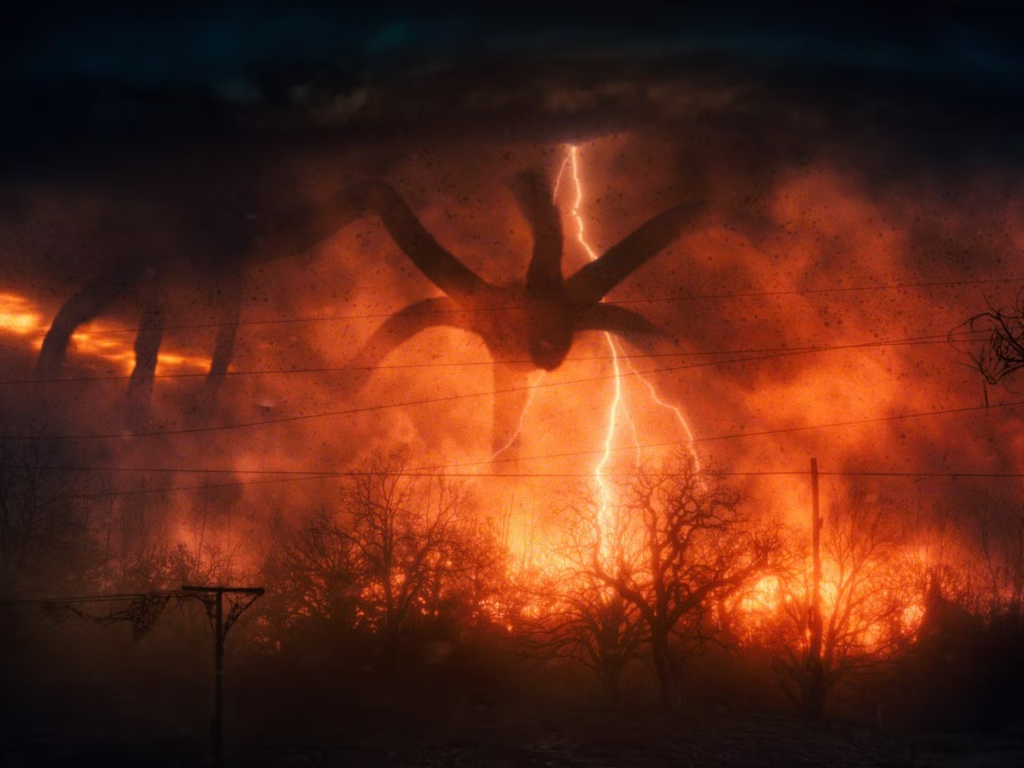
While the Upside Down itself is just a tunnel, it’s become infested with creatures from the Abyss that use it to access Earth.
The Mind Flayer: Not native to the Upside Down but to the Abyss. Originally a massive swarm of sentient particles, it was discovered and reshaped by Henry Creel into a spider-like entity with a flame-shaped head. The Mind Flayer possesses psychic abilities, can control other creatures, and has entered the consciousness of Will, Billy, and countless others in its goal to invade Earth.
Demogorgons: Predatory creatures from the Abyss with petal-like heads filled with teeth. They hunt through psychic connection to blood and fear. The Soviets captured several and kept them alive in Russian prisons, proving these creatures can survive outside their home dimension.
Demo-dogs: Adolescent Demogorgons in their middle growth stage, resembling hairless dogs with Demogorgon heads. They can tunnel underground and hunt in packs, connected to the Mind Flayer’s hive mind.
Demo-bats: Flying bat-like creatures with razor-sharp tails and teeth. They swarm victims in massive numbers, wrapping around throats and biting into flesh. These killed Eddie Munson in Season 4.
The Vines: Organic, root-like structures that pulse and react to threats. They spread throughout the Upside Down and beneath Hawkins, forming a tunnel system. When attacked, they cause pain to anyone connected to the hive mind, as Will experienced in Season 2.
How to Access the Upside Down
Throughout the series, multiple methods have opened gates between our world and the Upside Down:
The Mothergate: The original gate at Hawkins Lab, created when Eleven first made psychic contact with the Demogorgon in 1983. This massive portal allowed scientists to enter the dimension with protective suits and enabled creatures to breach our world. Eleven closed it in Season 1, but residual connections remained.
The Season 2 Gate: After being sealed, the gate at Hawkins Lab slowly began reopening as the Mind Flayer spread corruption beneath Hawkins through tunnel systems. Eleven closed it again at the end of Season 2, cutting off the psychic link.
The Russian Gate: Soviet scientists couldn’t open gates on their own soil because the Upside Down is specifically accessible in Hawkins, where Eleven first created the wormhole. They built a facility beneath Starcourt Mall and used massive amounts of energy to force open a new gate in 1985. Hopper and Joyce destroyed their machine, closing the gate and seemingly killing Hopper.
Vecna’s Gates: In Season 4, Vecna (Henry Creel) discovered he could create gates by killing victims through psychic torture. Each murder—Chrissy, Fred, Patrick, and Max—opened a small rift at the death site. His ultimate goal was opening four gates that would merge into a massive rift, allowing the Upside Down to bleed into Hawkins. He succeeded, tearing the town apart.
Temporary Membranes: Occasionally, thin barriers between dimensions form where the Upside Down pushes against our world. These organic membranes can be cut through, as Jonathan and Nancy did when hunting the Demogorgon in Season 1.
The Toxic Atmosphere and Time Distortion
The Upside Down’s atmosphere is poisonous to humans. Prolonged exposure causes respiratory damage, and the spores floating through the air make breathing difficult. When Joyce and Hopper rescued Will in Season 1, he had a tendril down his throat—the dimension was either feeding off him or using him for incubation purposes.
Time also behaves strangely in the Upside Down. While it appears frozen visually (stuck on November 6, 1983), time still passes for living creatures inside it. Will survived for days inside the dimension by hiding in his fort and using lights to communicate with Joyce. The environment ages and decays, but the structural echo of Hawkins remains unchanged.
Vecna’s Endgame: Merging the Dimensions
Vecna’s ultimate plan, revealed across Seasons 4 and 5, is to engineer a dimensional collision. The four gates he opened in Hawkins during Season 4 were merely demolition work, weakening the barrier separating Earth from the wormhole.
Unknown to the heroes, Vecna has also been creating rifts in the barrier separating the wormhole from the Abyss. By fracturing both ends of the bridge, Henry intends to pull the Abyss through the Upside Down and force it to merge with Earth. This convergence would obliterate the physical world, potentially terraforming Earth into a realm of monsters—or simply causing the extinction of all life.
Nancy witnessed visions of this apocalypse when Vecna showed her Hawkins being torn apart by gates and a “giant creature with a gaping mouth” looming over the town. That creature is likely the Mind Flayer in its full, unrestrained form from the Abyss.
Why the Upside Down Matters
The Upside Down isn’t just a setting—it’s the series’ central tragedy. Eleven didn’t know that protecting her friends from Henry would create a bridge to a nightmare dimension. She’s carried guilt for years, believing she unleashed this horror on Hawkins.
But the truth is more complex: Eleven saved the world by stopping Henry in 1983. If she hadn’t banished him, he would have killed everyone at the lab and continued his rampage. The Upside Down’s creation was an unintended consequence of choosing love and protection over power and destruction.
Now, as Season 5 concludes the series, the question isn’t just whether the heroes can close the gates—it’s whether they can destroy the wormhole itself, severing the connection between Earth and the Abyss forever. And that might require destroying the exotic matter holding reality together, a choice with potentially catastrophic consequences.
The Upside Down has been many things: a prison for Will, a weapon for Vecna, a home for monsters, and a constant reminder that protecting the people we love sometimes creates problems we never anticipated. As Hawkins faces its final battle, understanding this dark dimension might be the key to finally closing the door on the horrors that lurk just beneath the surface of our world.
Check out It’s Netflix Nerd for our latest reviews, updates, release news, and information about Netflix movies and series.