

I’ll never forget the first time I watched the Season 1 finale of Stranger Things. As the dust settled after Eleven’s epic showdown with the Demogorgon, I sat there staring at my screen, processing what I’d just witnessed. Where did she go? Did she survive? After rewatching the series multiple times and analyzing every frame of that climactic scene, I’ve developed a comprehensive understanding of what actually happened in those final moments—and why it matters so much for the entire series.
Explore Eleven’s Full Character Analysis →
What Actually Happened
When Eleven confronts the Demogorgon in Hawkins Middle School, she’s already pushed her abilities to the breaking point. Throughout the season, I noticed how each use of her powers caused physical strain—nosebleeds, exhaustion, even unconsciousness. But this final battle required something unprecedented: complete annihilation of a creature from another dimension.
As Eleven places her hands on the Demogorgon, something extraordinary happens. She doesn’t just kill it; she disintegrates it entirely while simultaneously vanishing herself. The visual effects show both of them dissolving into particles, suggesting they didn’t simply disappear—they were transported somewhere else. Based on my analysis of the show’s mythology and subsequent seasons, Eleven was pulled into the Upside Down along with the Demogorgon during their mutual destruction.
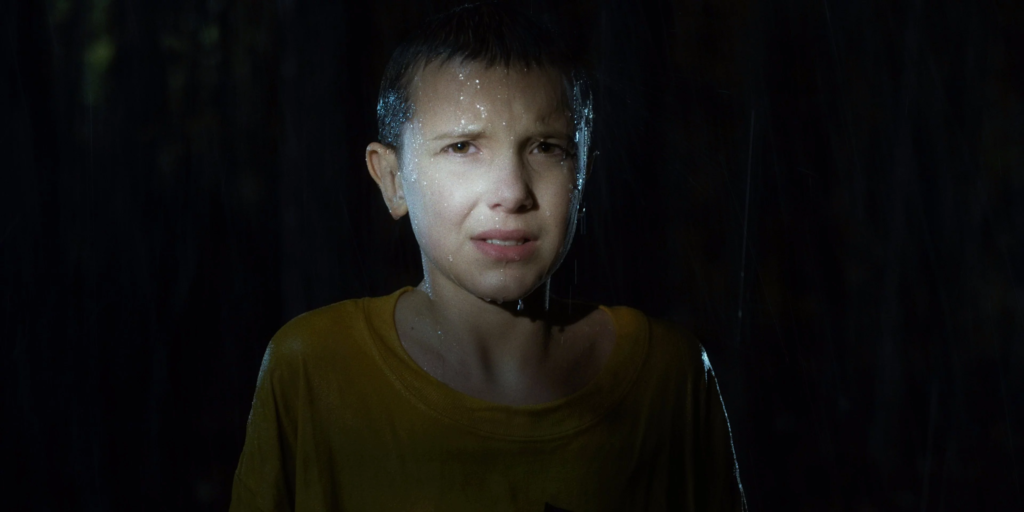
The Upside Down Connection
Here’s what I’ve pieced together about the mechanics of Eleven’s disappearance. The Upside Down operates as a dark mirror of our reality, a parallel dimension that Eleven herself accidentally opened during her encounter with the Demogorgon at Hawkins Lab. Throughout Season 1, we see that certain areas can serve as portals between dimensions—the tree where Will was taken, the gate in the lab, even the temporary rift in the Byers’ living room.
When Eleven used the full extent of her powers against the Demogorgon, she essentially created an unstable portal. The sheer energy required to destroy an interdimensional creature while already weakened meant she couldn’t maintain her position in our dimension. I believe she was caught in a psychic backlash that pulled her into the very dimension she’d been fighting to close.
The Evidence in Plain Sight
Watching the finale again with this understanding, I noticed several clues the Duffer Brothers planted. First, there’s the way both Eleven and the Demogorgon fragment into identical particle effects—they’re experiencing the same dimensional shift. Second, in the post-credits scene where Hopper leaves Eggos in the woods, we get our confirmation: Eleven is alive, somewhere.
But here’s what fascinated me most during my rewatch: Eleven’s journey mirrors Will’s experience. Will survived in the Upside Down for over a week using his knowledge of Hawkins and finding pockets of safety. Eleven, with her psychic abilities and survival skills honed from years of laboratory imprisonment, would be even better equipped to navigate that hostile dimension. She could sense danger, locate food (if any existed), and potentially find her way back.
The Scientific and Supernatural Balance
What makes Stranger Things brilliant is how it balances scientific concepts with supernatural elements. The show draws from real-world experiments like the CIA’s Project MKUltra and theoretical physics concepts about parallel dimensions. From my understanding of the show’s logic, Eleven exists in a quantum state during her disappearance—she’s technically between dimensions, using her remaining psychic energy to survive and eventually find a way home.
Her powers, which were initially created through experimentation with sensory deprivation and psychic enhancement, allow her to perceive and interact with dimensional barriers in ways normal humans cannot. When she destroyed the Demogorgon, she didn’t die—she became temporarily untethered from our reality.
Why This Matters for the Series
Understanding Eleven’s disappearance is crucial for appreciating the entire Stranger Things mythology. This moment establishes several key principles: interdimensional travel is possible but dangerous, Eleven’s powers come with severe costs, and the Upside Down exerts a pull on those who interact with it.
I’ve noticed that this ending also serves as the emotional foundation for everything that follows. Mike’s grief and hope, Hopper’s protective instincts, and Eleven’s own journey of self-discovery all stem from these final moments of Season 1. The show asks us to believe that love and connection can transcend dimensions—literally.
The Hopper Connection
The final scene with Hopper leaving Eggos in the forest box tells us something important: he knows she’s alive, or at least suspects it strongly enough to take action. Given Hopper’s law enforcement background and his access to information about the lab’s activities, I believe he understood more about the nature of Eleven’s powers and the Upside Down than he initially let on. His faith in her survival proves justified, but that’s a story for Season 2.
When I first finished Season 1, I was desperate for answers. Now, I appreciate how perfectly that ending balanced resolution with mystery, giving us enough information to understand what happened while leaving us eager to see how Eleven would return. That’s the mark of exceptional storytelling—and why Stranger Things became a cultural phenomenon.